Twenty-five years ago, in 1998, judges and winners for the Writers and Illustrators of the Future Contests were asked to answer this question: “With the rapid development and vast expansion of computer technology, how do you think the fundamentals of education will be taught to our children by the year 2023?”
And now in 2023, a quarter-century later, that time capsule was opened at the L. Ron Hubbard Achievement Awards Gala in front of a full house at the Taglyan Complex in Hollywood and to over 430,000 viewers and an additional 1.2 million listeners.
Education quality has been a hotly discussed topic. Contest founder L. Ron Hubbard earlier made this very insightful observation, “A culture is held together solely and only by education. Whether that education is accomplished by experience or by teaching, a culture as a whole is the summation of its education.”
Thirty-one science fiction and fantasy writers and illustrators placed their answers in the capsule. After all, who would be better to predict the future than the heralds of that future? But were their predictions accurate?
During the awards ceremony, Gunhild Jacobs, Executive Director Author Services, Inc., and event emcee called Contest judges Tim Powers (On Stranger Tides) and Kevin J. Anderson (Dune Prequels) to the stage to cut the seal and open the time capsule.
Gunhild Jacobs rapidly scanned through the predictions and gave Kevin Anderson the one made by Tim Powers a quarter century ago. “Voice recognition & transcription programs will have made literacy (all of spelling & most of grammar) obsolete; math-competent people will assume control, morality will be discarded as archaic, & the common people will be bred for food.” The audience moaned as Kevin quipped that he hoped everyone enjoyed their steak tonight. To which Tim Powers responded that he “may have been a bit ahead of the curve.”
Tim Powers was then handed the prediction made by famed Golden Age Dean of Science Fiction Artists Frank Kelly Freas, “Much as usual—badly.”
Here is a selection of other predictions found in the time capsule.
Grand Master of Science Fiction Jack Williamson (one of the originators of the term “genetic engineering”) anticipated education “by bio-silicon brain implants,” while Writers of the Future Coordinating Judge Algis Budrys (Rogue Moon) forecasted, “On computers. 26 years from now, some other technology will be ready.”
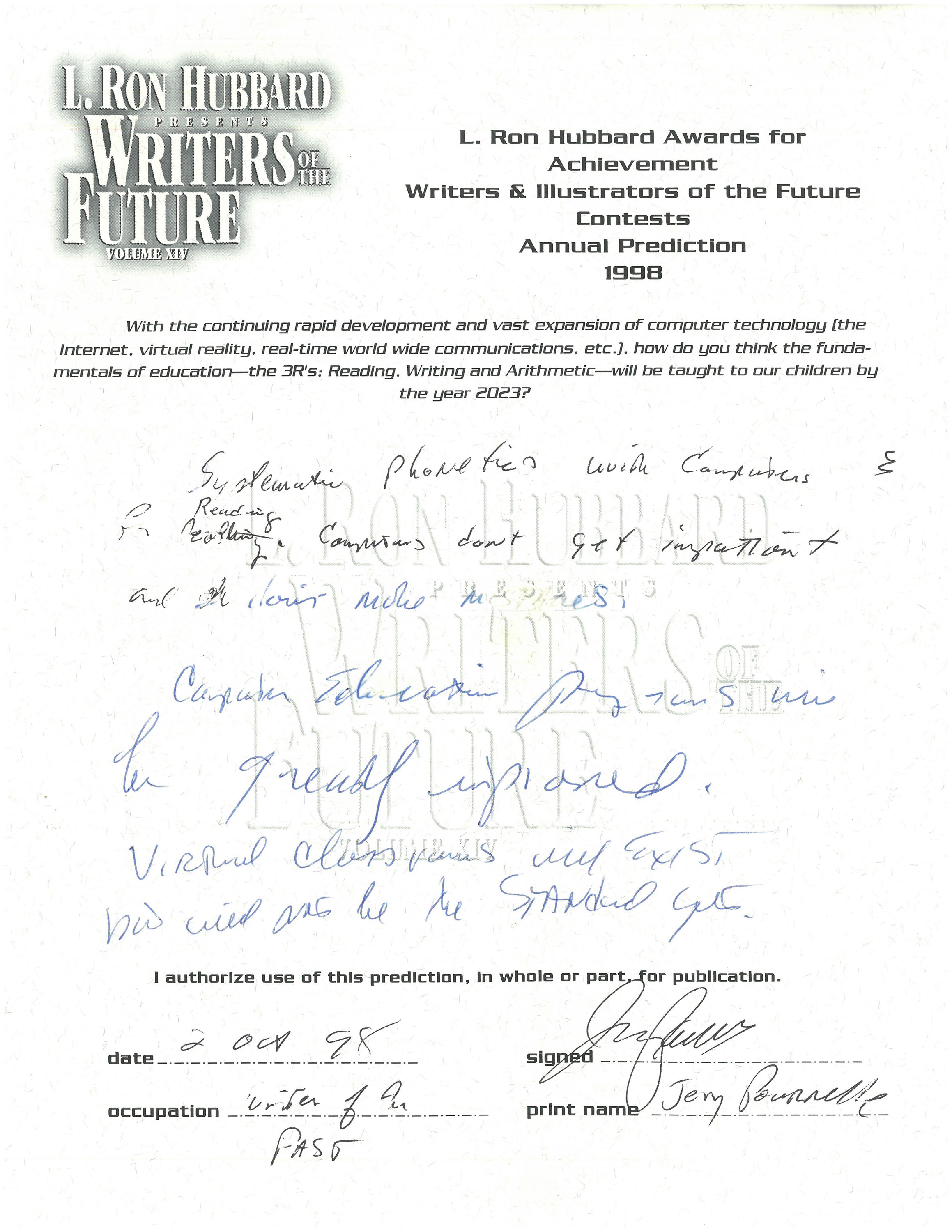
Scientist, international best-selling author, and creator of the science blog Chaos Manner, Dr. Jerry Pournelle (Mote in Gods Eye and Luciefer’s Hammer) appears to have gotten it closest, “Systematic phonetics with computers for reading. Computers don’t get impatient and don’t make mistakes. Computer education programs will be greatly improved. Virtual classrooms will exist but will not be the standard yet.”
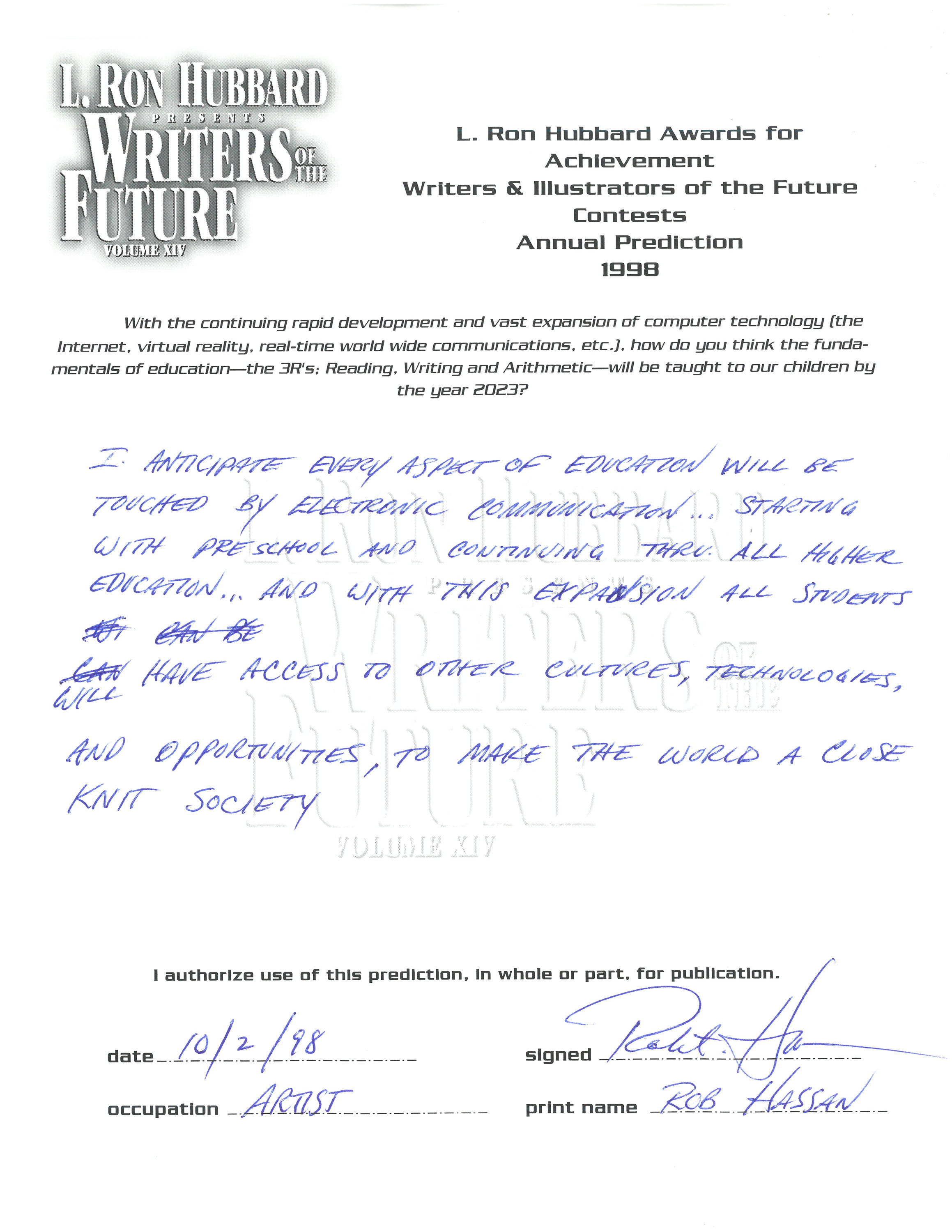
Award-winning science fiction and fantasy artist Rob Hassan wrote, “I anticipate every aspect of education will touch electronic communication starting with pre-school and continuing through all higher education and with this expansion, all students have access to other cultures, technologies, and opportunities, to make the world a close-knit society.”
While others were somewhat dire. Award-winning horror writer, Scott Nicholson, provided his view of a dystopian future by 2023, “By direct implant via brain wave resonators, all knowledge will be controlled by government agencies.”
Chesley award-winning illustrator, Val Lakey Lindahn, foresaw that “The fundamentals of education will be primarily to teach the children to find fresh water—a precious commodity due to overpopulation.”
Check out all the predictions below…
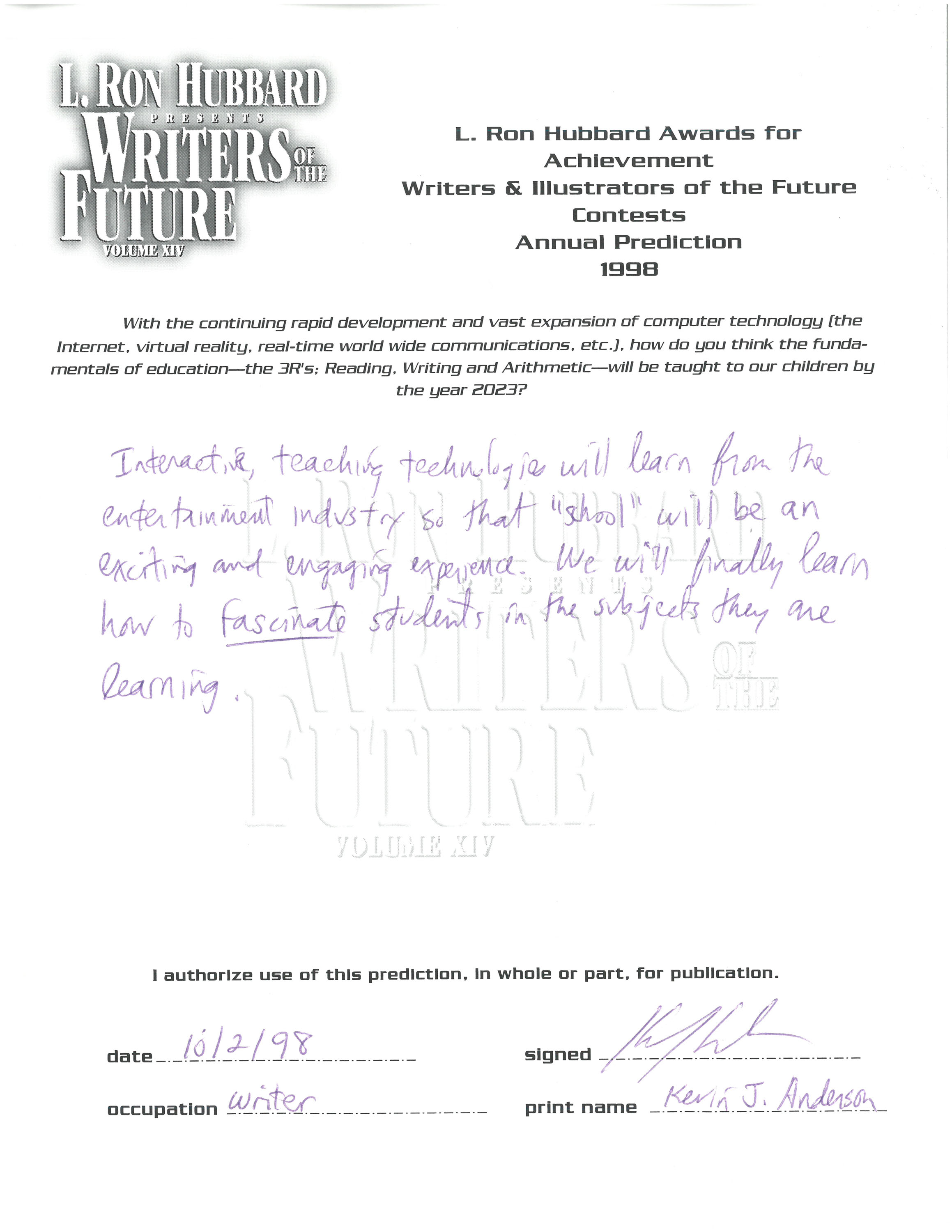
Kevin J. Anderson, Writers of the Future Judge:
Interactive, teaching technologies will learn from the entertainment industry so that “school” will be an exciting and engaging experience. We will finally learn how to fascinate students in the subjects they are learning.
Scott M. Azmus, 9th/10th Grade Biotechnology Teacher:
By the year 2023, students will not be grouped in grades according to age. They will be grouped by ability to meet National and local Standards and Benchmarks. There will be no classrooms or schools or teachers. All education will be delivered directly to the home.
The mind-brain computer interface will facilitate a “boom” in education. Despite these advances, 9th graders will still be too socially-minded to learn. Yes, hormones.
Janet Berliner, writer:
After the 2022 Revolution against misuse of the Internet, the intelligentsia rid themselves of their computers. By 2023, arithmetic was taught through the use of abaci (counting device), the fashionable had them custom made, using gems and rocks as beads. Pens and ink (blue-black of course) were back in style and used to teach penmanship. As for reading…they reinvented books.
Jayme Blaschke, Hospital PR, published finalist:
VR Technology will allow high school students to participate in college-level courses accelerating the depth and quality of education nation-wide.
Algis Budrys, late Writers of the Future Coordinating Judge:
On computers. 26 years from now, some other technology will be ready.
Gene Bundy, librarian:
I see a future where the tide will turn back to books. There is just so much garbage on the internet that people realizing that quality counts will be forced to use books. Or, the electrical supply system will crash and a good old book will be the only surviving source of information.
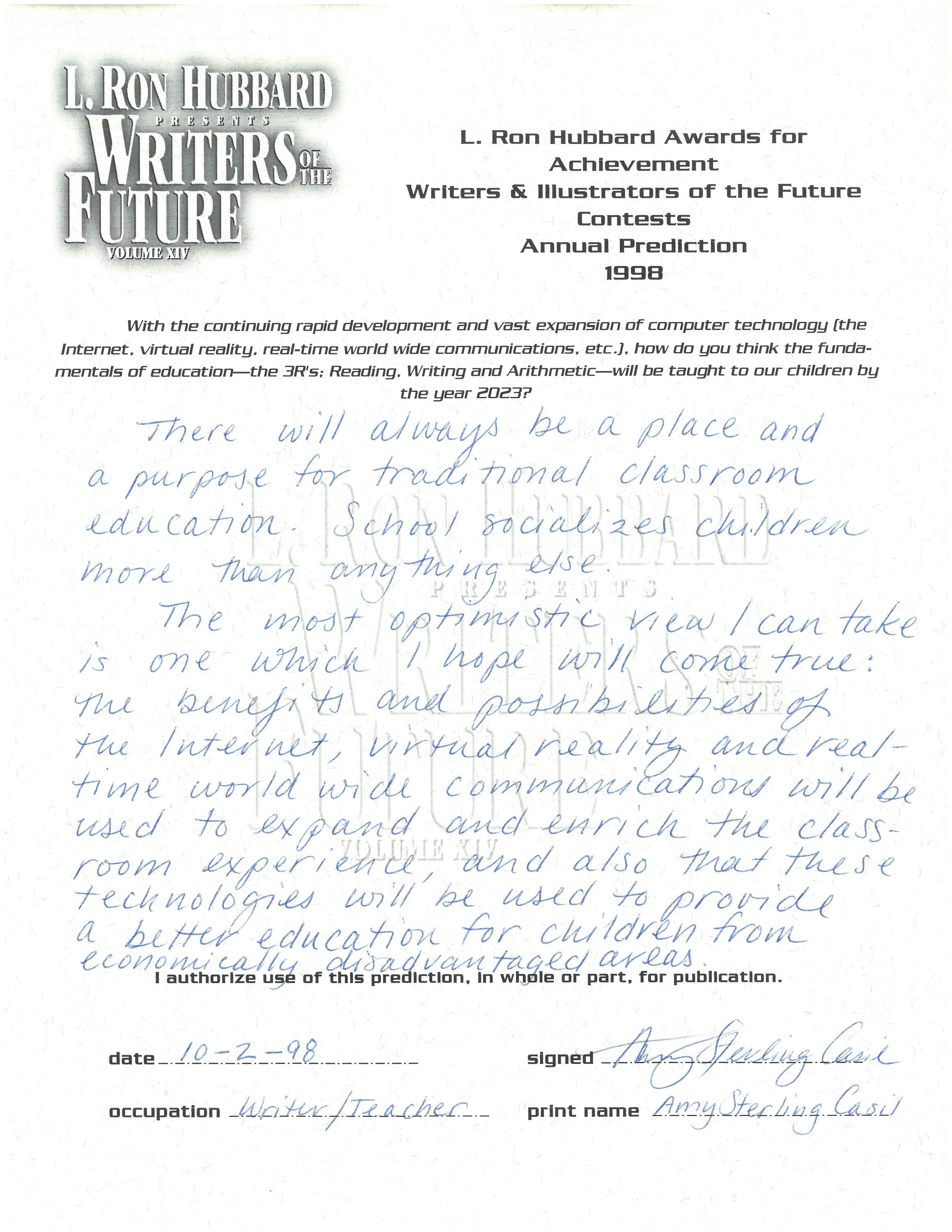
Amy Sterling Casil, writer/teacher, WOTF winner:
There will always be a place and a purpose for traditional classroom education. School socializes children more than anything else.
The most optimistic view I can take is one which I hope will come true: the benefits and possibilities of the internet, virtual reality and real-time worldwide communications will be used to expand and enrich the classroom experience, and also that these technologies will be used to provide a better education for children from economically disadvantaged areas.
Ronald Collins, Engineer, WOTF winner:
I think schools will become global in nature as information becomes cheaply and easily available. I see mastery learning and “around the clock”―self-paced coursework. I see lectures virtually attended by students around the world and local centers for working personally.
I think this will result in parents having a greater involvement in children’s education―perhaps even requiring electronic signatures in some institutions.
Chris A. Flamm, artist/writer, WOTF winner:
I predict a severe backlash to psychiatric based education, and a re-emphasis on the basics, as well as a thorough grounding in languages and greater awareness of global interdependencies.
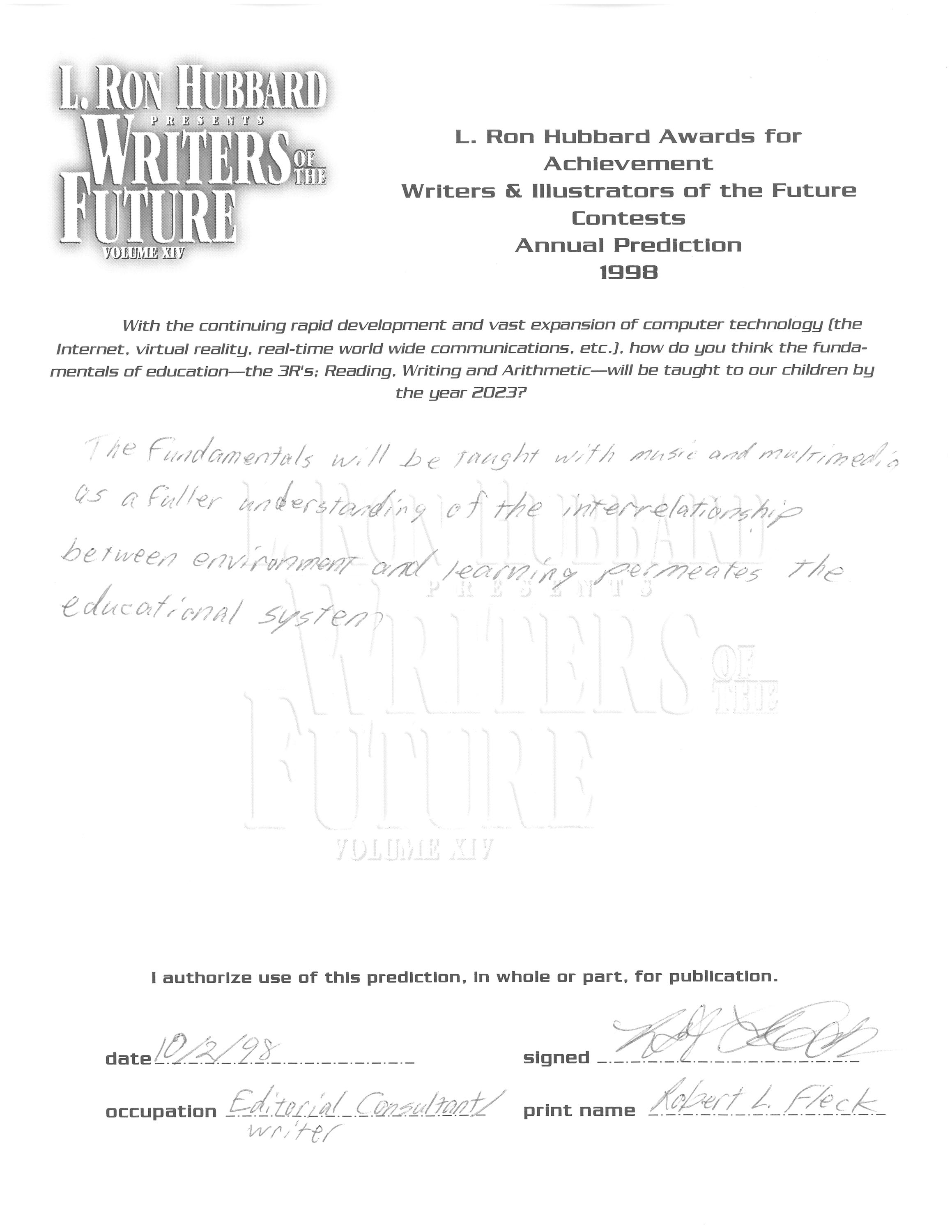
Robert L. Fleck, editorial consultant/writer:
The Fundamentals will be taught with music and multimedia as a fuller understanding of the interrelationship between environment and learning permeates the educational system.
Richard Flood, computer systems architect:
Largely as they are today. While futuristic web-based training (probably more virtual reality than today) and other automated teaching methods will be adjuncts to save teacher salaries, the human-contact factor will prove crucial to children’s education and well-being.
Dionisios Fragias, artist, IOTF winner:
Classrooms will be able to view virtual reality plays/reenactments of historical events and various pieces of literature and possibly participate as well as read along in their ultra-thin electronic notebooks. Every child will be required to have this by the Board of Education.
Classrooms will be reduced in size as more and more groups of students will be required to converge in small groups at places of residence rather than commuting part of the time. Here a remote instructor will monitor and teach through the use of the available hardware.
Work, such as mathematics or English composition will done in that one electronic notebook. Every subject will be wirelessly downloaded or stored in its memory. The device will serve for multimedia functions screens will unfold to adequate size from the unit, making it ideal for any audio visual interaction.
Frank Kelly Freas, late Illustrators of the Future Coordinating Judge:
Much as usual—badly.
Laura Brodian Freas, Illustrators of the Future Judge:
It will have been discovered how to electronically program material directly into human brains. With the exception of deportment, social interaction, and physical training all knowledge will be acquired with a combination of pulse patches (formerly known as electrodes) and beams of light into the eyes.
Rob Hassan, Artist, IOTF winner:
I anticipate every aspect of education will be touched by electronic communication…starting with pre-school and continuing thru all higher education…and with this expansion all students have access to other cultures, technologies, and opportunities, to make the world a close-knit society.
Tim Jansen, writer, WOTF winner:
Individual instruction for each student, tailored to his needs & the wishes of his parents. By use of computer education program that adapts to the student’s progress. Virtual reality teachers. Plus regular classroom sessions with real teachers. (combined)
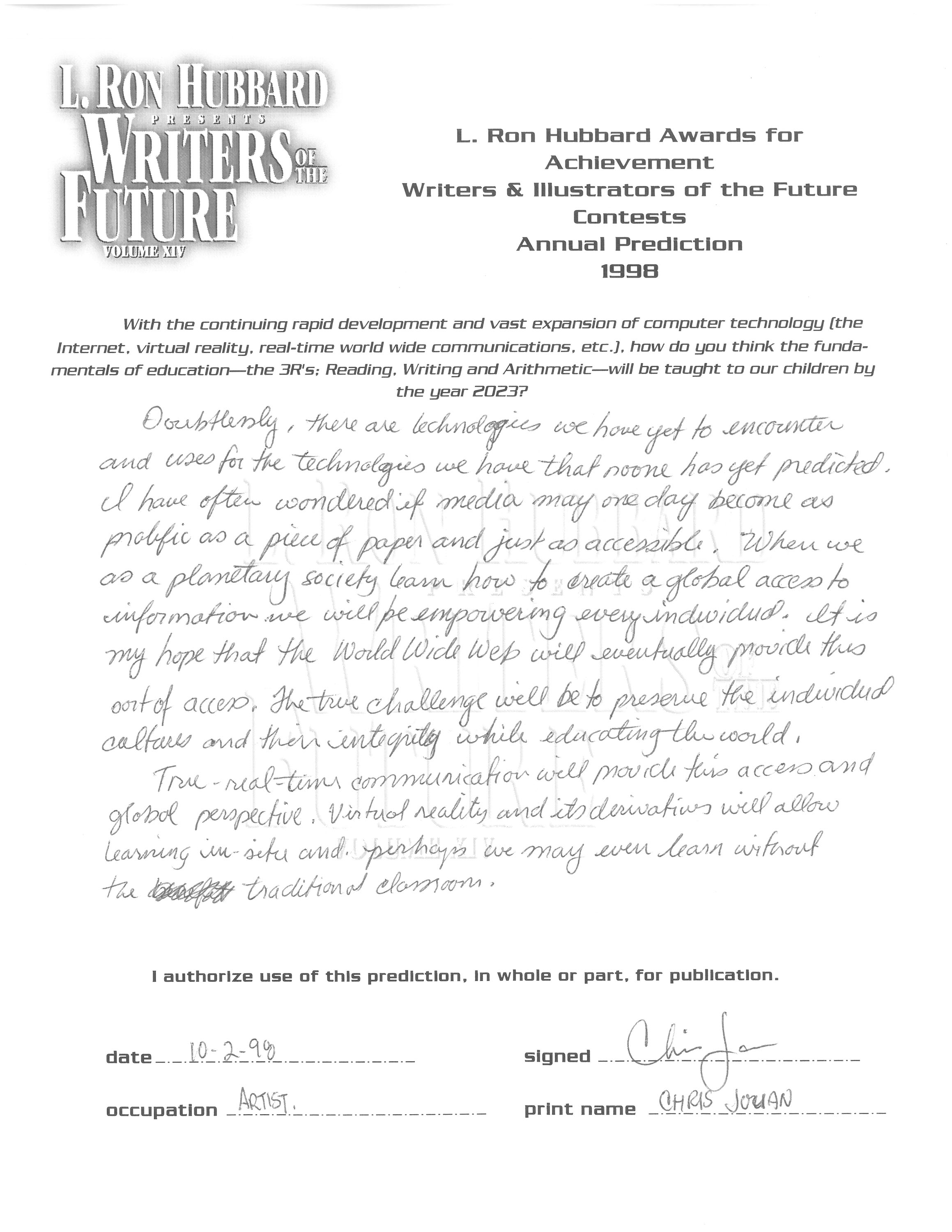
Chris Jouan, artist, IOTF winner:
Doubtlessly, there are technologies we have yet to encounter and uses for technologies we have that no one has yet predicted. I have often wondered if media may one day become as prolific as a piece of paper and just as accessible. When we as a planetary society learn how to create a global access to information we will be empowering every individual. It is my hope that the World Wide Web will eventually provide this sort of access. The true challenge will be to preserve the individual cultures and their integrity while educating the world.
True—real—time communication will provide this access and global perspective. Virtual reality and its derivatives will allow learning insights and perhaps we may even learn without the traditional classroom.
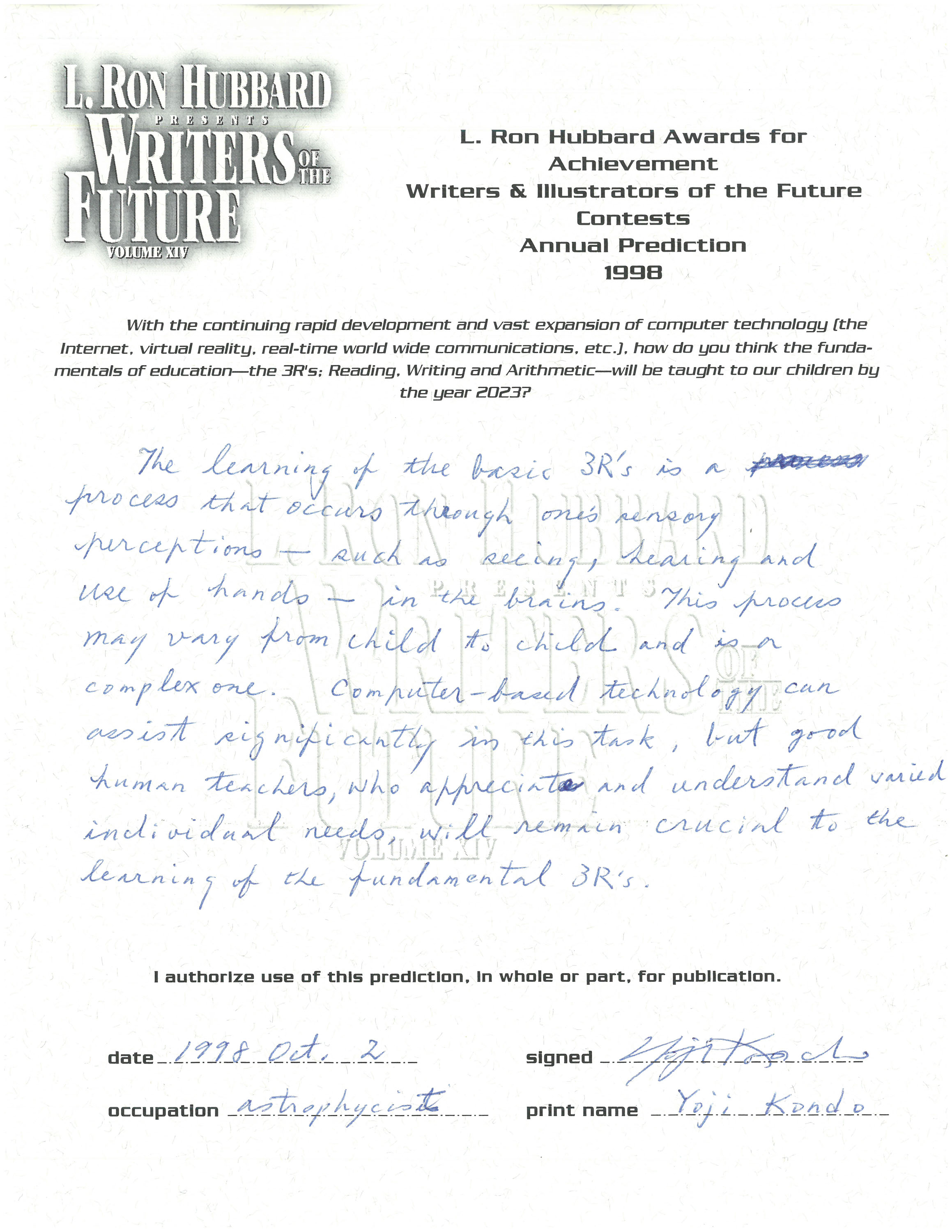
Yoji Kondo, astrophysicist, late Writers of the Future Judge:
The learning of the basic 3R’s is a process that occurs through one’s sensory perceptions—such as seeing, hearing and use of hands—in the brains. This process may vary from child to child and is a complex one. Computer based technology can assist significantly in this task, but good human teachers, who appreciate and understand varied individual needs, will remain crucial to the learning of the fundamental 3R’s.
Paula Lehr, retired social worker:
I think the basic fundamentals will be taught to children by use of computers and other advanced communication devices before they enter school. And that computers will help standardize the basics across the country.
Val Lakey Lindahn, Illustrators of the Future Judge:
The fundamentals of education will be primarily to teach the children to find fresh water―a precious commodity due to over population.
John A. Lock, artist, IOTF winner:
It’s difficult to say where man will be in the future based on how the world of politics and greed have slowed the advances we already should have made. Without interference I could see the use of the computer keyboard or verbal interface being the main form of writing possibly to a point where handwriting is hardly used. Since reading off of a screen is or can be detrimental to eyesight I still see the use of printed books not being hampered. Also since most banking will be automated the use of higher mathematics I see being only used (if not available) to programmers and such. I think visual imagery however will be more widely used as a way of communicating to the masses. I hope that through computers there will be broader access of higher learning available to even the common man rather than just to those who can afford it.
Paul Marquis, Illustrator:
The 3Rs will be taught via channels on Television/Computer/internet screens. Huge corporations will sponsor edutainment with their products plugged throughout. The most expensive pay channels will have the best courses. Courses covered will include iconic reading (the western alphabet will be dead), writing limited to conversational speech, and arithmetic limited to basic programming functions.
Rebecca Moesta, Writers of the Future Judge:
By 2023 teachers will be facilitators, who draw on an arsenal of interactive and adaptive educational “weaponry” to educate each child in the optimal way for that child. Resources my include: human teachers, electronic slates, music, games and stories with embedded learning functions, physical activities, combined with neural feedback to shape desired responses and discourage undesirable ones.
Carla Montgomery, writer, WOTF winner:
Children will be taught by interaction with their own virtual tutor “who” challenges them at a pace tailored specifically to their individual needs. An interactive holographic mentor who tailors problem sets, essay topics and readings designed to pique particular students interests and challenge their abilities.
Scott Nicholson, newspaper writer, WOTF winner:
By direct implant via brainwave resonators; all knowledge will be controlled by government agencies.
Jerry Pournelle, late Writers of the Future Judge:
Systematic phonetics with computers for reading. Computers don’t get impatient and don’t make mistakes. Computer education programs will be greatly improved. Virtual classrooms will exist but will not be the standard yet.
Roberta Pournelle, software developer:
There is likely to be two more separate strains in education. There will be students prepared in the classical manner who are taught to read and write & cypher. The other tier will be technology impacted to the point where the CPU will read to them & through voice recognition CPU will write for them. All styles will be created attached to personal mice with their signature embedded. A touchy-feely head set provides sensory input. A have & have not.
Tim Powers, Writers of the Future Judge:
Voice recognition & transcription programs will have made literacy (all of spelling & most of grammar) obsolete; math-competent people will assume control, morality will be discarded as archaic, & the common people will be bred for food.
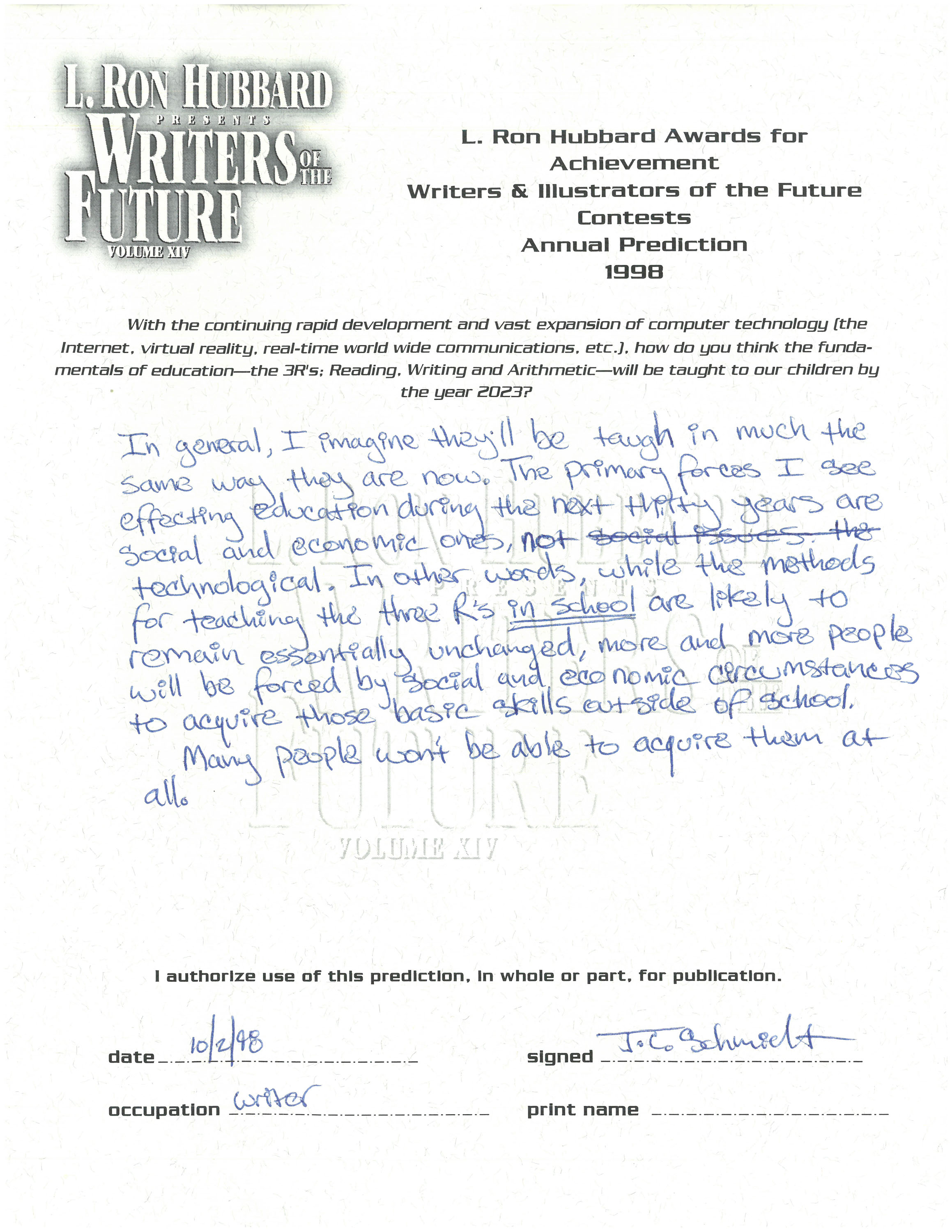
J.C. Schmidt, writer, WOTF winner:
In general, I imagine they’ll be taught in much the same way they are now. The primary forces I see effecting education during the next thirty years are social and economic ones, not technological. In other words, while the methods for teaching the three Rs in school are likely to remain essentially unchanged, more and more people will be forced by social and economic circumstances to acquire those basic skills outside of school.
Many people won’t be able to acquire them at all.
Carl Schnurr, Producer:
Unfortunately, I don’t think that lower education will change that much in the next 25 years. The only thing I see happening is the increased number of choices in lower education—that’s it. In higher education, there’s a chance it will become more decentralized as college costs continue to increase.
T.M. Spell, Secretary:
There will be cybernetic chips that can be plugged directly into the skull that will directly educate the brain in a variety of subjects. In addition to the 3 Rs, there will be foreign language implants that will make it possible to learn a language and speak like a native, with complete knowledge of a culture’s history in less than a day.
Brian S. Wightman, writer, WOTF winner:
Educations at the elementary level remains fairly constant throughout time in most ways. Computer technology, will, however, diminish community colleges, and hamper all but the elite liberal arts schools. Online education will replace this. VR, if developed, could allow even science labs through networks.
Jack Williamson, late Writers of the Future Judge:
By bio-silicon brain implants.
Eric L. Winter, illustrator:
I think most, if not all school classrooms in 25 years will be equipped with individual computer databases at each desk. Virtual reality will be used to teach students history and to take them to new worlds. To also learn new skills through virtual reality. The internet will be accessible from everywhere. Reading in books will unfortunately continue to decline, but continue to grow on computers. Arithmetic will be done by computer and less by humans. Much of the above will be at home, rather than in school buildings. Though schools and universities will continue, the teaching format will gradually shift to more computer/internet oriented instruction. Writing as it is now will just continue to be written on computers. And more voice activated systems will even replace typing.